Wednesday, 16 February 2011

Ping Pong...

The Parliamentary Voting System and Constituencies Bill is now set to ping pong between the Commons and the Lords after Peers have defeated the government by 277 votes to 215 on the amendment tabled by Lord Rooker, which insists that the AV referendum is subject to 40 per cent turnout threshold. It is worth noting that the first vote on this amendment was carried by one vote, so supportive contributions from Lord Lamont and Lawson have clearly had an impact with the Tory rebellion increasing from 10 to 27.
The stakes are high, with the AV referendum being a central tenet of the Liberal Democrats achievements since entering into the coalition government. Both Houses of Parliament look set for a sleep deprived night of legislative ping pong.

If the Bill fails to receive ascent this week, the May 5th referendum date is out the window, which will be terrible news for Nick Clegg and his party, and all this when things were beginning to look up with polling now suggesting the Yes campaign is ten points ahead.

Monday, 18 October 2010

Alan Johnson urges government to rethink

Shadow Chancellor Alan Johnson today reiterated the Labour Party's commitment to reducing the deficit in four years. In a short speech which lacked detail, he argued for "targeted tax changes" to play a bigger role in deficit reduction and economic recovery.

In his first speech since being appointed to the Shadow Cabinet, Johnson lamented the Coalition for making unfair choices on a number of measures and taking a "reckless gamble", but did state that Labour would not oppose all the cuts implemented. Johnson consistently referred to growth throughout his speech, claiming that Coalition policy endangered recovery.

Overall, a speech which illuminated the direction Labour plan to head on the economy, in which he stated "speed does matter". In short, Labour's growth plan v's the Coalition's dangerous austerity plan. 

Wednesday, 13 October 2010

Beginners luck?

An initially nervous performance from Ed Miliband in his first outing at PMQs progressed into a sure footed attack on the Government’s controversial child benefit policy. Miliband’s questions focused on the specific affects the new policy will have on middle income families, the PM responded with a general defence of the Government’s agenda and lamented Labour for leaving the country in such a dire economic state.
Overall, a solid first performance from Ed Miliband which will slightly worry Cameron’s team, though they will be aware that Ed can only attack for so long, before presenting alternatives. The Labour team are attempting to do just that in time for the CSR next week. Interestingly Ed’s brother had private engagements today and couldn’t make it to the chamber. 

Friday, 8 October 2010

The new shadow cabinet...


Leader of the Opposition    
Rt. Hon. Ed Miliband MP

Deputy Leader and Shadow Secretary of State for International Development    

Rt Hon Harriet Harman MP

Shadow Chancellor of the Exchequer    

Rt Hon Alan Johnson MP

Shadow Secretary of State for Foreign and Commonwealth Affairs and Minister for Women and Equalities    

Rt Hon Yvette Cooper MP

Shadow Secretary of State for the Home Department    

Rt Hon Ed Balls MP

Chief Whip    

Rt Hon Rosie Winterton MP

Shadow Secretary of State for Education and Election Coordinator    

Rt Hon Andy Burnham MP

Shadow Lord Chancellor, Secretary of State for Justice

Rt Hon Sadiq Khan MP

Shadow Secretary of State for Work and Pensions    

Rt Hon Douglas Alexander MP

Shadow Secretary of State for Business, Innovation and Skills    

Rt Hon John Denham MP

Shadow Secretary of State for Health    

Rt Hon John Healey MP

Shadow Secretary of State for Communities and Local Government    

Rt Hon Caroline Flint MP

Shadow Secretary of State for Defence    

Rt Hon Jim Murphy

Shadow Secretary of State for Energy and Climate Change    

Meg Hillier MP

Shadow Leader of the House of Commons    

Rt Hon Hilary Benn MP
Shadow Secretary of State for Transport    
Maria Eagle MP

Shadow Secretary of State for Environment, Food and Rural Affairs    

Mary Creagh MP

Shadow Chief Secretary to the Treasury    

Angela Eagle MP

Shadow Secretary of State for Northern Ireland    

Rt Hon Shaun Woodward MP

Shadow Secretary of State for Scotland    

Ann McKechin MP
Shadow Secretary of State for Wales    
Rt Hon Peter Hain MP
Shadow Secretary of State for Culture, Media and Sport    
Ivan Lewis MP

Shadow Leader of the House of Lords    

Baroness Royall of Blaisdon

Shadow Minister for the Olympics    

Rt Hon Tessa Jowell MP

Shadow Minister for the Cabinet Office    

Rt Hon Liam Byrne MP

Lords Chief Whip    

Lord Bassam of Brighton

Shadow Attorney-General    

Baroness Scotland

Wednesday, 18 August 2010

100 days...


There's nothing special about the first 100 days of any new Government except that everyone marks it as an important milestone.  Rarely will the Government's most important actions have been completed in this arbitrary time period.  Rarely will historians look back and say, "that first 100 days set the tone for the whole administration".  Nevertheless, first impressions matter and the "Big Mo" - momentum - is key to political success.

So, has anything momentous actually happened?

The speed the new Government has set to work has been astonishing, many predicted the very nature of coalition arrangements would make for cumbersome and piecemeal policy advances, oh how wrong they were. The deficit reduction narrative has of course allowed for such swift action, government departments have been falling over themselves to slash costs, Quangos have been heavily culled, crowd sourcing has been used like never before, a raft of information on public spending has been made public. This gives only a flavour of what the coalition has achieved in its first 100 days and interestingly public support is holding.
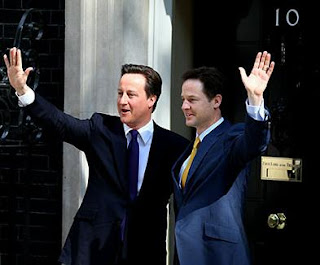
However, the polls do suggest that the Liberal Democrats are not faring well, Nick Clegg is at pains to remind us that his party should be judged over five years and not 100 days. He will be hoping for a much needed boost in the approval ratings in what is sure to be a carefully managed series of Autumn conference policy announcements. But perhaps Nick Clegg does deserve a little early credit, given that he has managed to steer his party relatively well thus far, there has been little in the way of backbench grumbling and the idea of rebellion seems a distant one at present. Nevertheless, the Lib Dems have a serious image problem and one in which they will ultimately need their coalition partner's assistance to resolve. 

It seems the public are offering David Cameron full credit for the efficient running of the Coalition Government. His personal approval rating and that of his party are high, rebellion again seems distant and despite some backbench disgruntlement over former Labour ministers being appointed to Government roles, it seems his ship is also steady and on course. It would be silly, not to question the durability of the coalition at this stage, whilst the majority of public affairs professionals who took part in a recent poll suggested that the coalition had a lifespan of two years. I'm willing to bet that the coalition will continue as is, until the fifth year when inevitably the seams will begin to fray beyond repair. Until that point, expect the brisk pace of legislative reform to continue.

Overall, the first 100 days can be viewed as a success, the way in which the coalition partners have gelled has been and continues to be remarkable. The idea of such a strong coalition during the election campaign was unfathomable.

Tuesday, 22 June 2010

Emergency Budget

The Chancellor today delivered his emergency budget, which he dubbed "unavoidable" in a bid to set the tone for a swathe of cuts to public spending and tax increases. The budget will form the backdrop to the forthcoming Comprehensive Spending Review, announced 20 October 2010, which will provide a breakdown of departmental cuts. 
Headline measures in today's budget include:
  • Structural current deficit to be in balance by 2015 and debt to be falling as a percentage share of GDP 
  • Spending cuts will account for 77 per cent of deficit reductions, while 23 per cent from tax rises 
  • From 4 January 2011 VAT will be raised to 20 per cent 
  • The income tax personal allowance will be increased by £1,000 to £7,475 
  • The corporation tax rate will be cut by one per cent per year for four years, from 28 to 24 per cent and the small firms’ rate will be cut to 20 per cent. Capital and investment allowances will be reduced, but this will be delayed until 2012 
  • Capital gains tax to be raised to 28 per cent for higher rate tax payers 
  • A bank balance sheet levy will be introduced from January 2011 to eventually generate over £2 billion annually 
  • From April 2011 the employer national insurance contributions threshold will rise by £21 a week above inflationary rises 
  • No rises in alcohol, tobacco or fuel duty – alcohol and fuel duties, including air passenger duty, to be considered in the autumn 
  • Part of Royal Mail to be sold off to raise investment capital 
  • The government will implement the recommendations of the Dyson review into R&D tax credits and expand the enterprise finance guarantee scheme 
  • The government will publish a White Paper on tackling regional economic differences in Britain later in the summer, followed by a paper on rebalancing the economy of Northern Ireland 
Full Budget document available here.